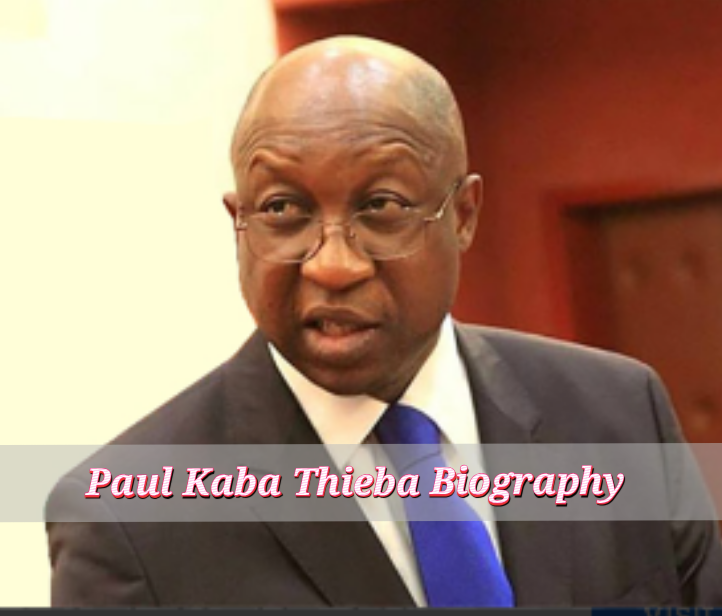
Paul Kaba Thieba Biography
Paul Kaba Thieba is a Burkinabé economist and former Prime Minister of Burkina Faso. He served as head of government from January 6, 2016, to January 18, 2019, under President Roch Marc Christian Kaboré. Before entering politics, he spent more than 20 years working in central banking and regional finance in West Africa. He is known for being calm, professional, and focused on results rather than public attention. His time as Prime Minister came right after the 2014 popular uprising that removed long-time president Blaise Compaoré, so he led the country during a very sensitive transition period. Thieba is respected for his deep knowledge of economics and his clean reputation.
Paul Kaba Thieba Early Life
Paul Kaba Thieba was born on July 28, 1960, in Bobo-Dioulasso, the second-largest city in what was then called Upper Volta (now Burkina Faso). He grew up in a middle-class family. His father worked at the Central Bank of West African States (BCEAO), so young Paul often heard conversations about money, banking, and development at home. This early exposure planted the idea that finance could help improve people’s lives.
He is from the Mossi ethnic group, the largest in Burkina Faso, and was raised as a Roman Catholic. Thieba has always described himself as a family-oriented person. He is married and has three children. Even though he later became a national figure, he kept his family life private.
Paul Kaba Thieba Education
Thieba was a strong student from the beginning. He completed his secondary education at Lycée Philippe Zinda Kaboré in Ouagadougou and earned his baccalauréat in 1979. After that, he stayed in Burkina Faso for his first university degrees:
- Bachelor’s degree in Business Administration (1982)
- Master’s degree in Management (1983) from the University of Ouagadougou
In 1984, he moved to France for advanced studies. He earned:
- A postgraduate diploma (DEA) in Economics from University of Grenoble II
- A PhD in Economics from the same university in 1987
- A specialized master’s degree (DESS) in Banking and Finance from Paris Descartes University in 1988
These degrees gave him excellent training in economics, monetary policy, and banking, skills that later became very useful in his career.
Paul Kaba Thieba Career
Thieba started his professional life in France at Caisse des Dépôts et Consignations, a major public financial institution. In 1993, he returned to West Africa and joined the Central Bank of West African States (BCEAO) in Dakar, Senegal. His career progressed steadily:
- 1998–2000: Head of Foreign Exchange Department
- 2000–2006: Director of Financial Operations
- 2006–2011: Assistant Director of Financial Operations
- 2012–2014: Chief Operating Officer of BCEAO
- 2014–2015: Managing Director of the Financial Stability Fund of UEMOA (West African Economic and Monetary Union)
During these years, he helped keep the CFA franc stable and supported financial policies for eight West African countries. Colleagues remember him as serious, hardworking, and always prepared.
Time as Prime Minister
On January 6, 2016, President Roch Marc Christian Kaboré appointed Paul Kaba Thieba as Prime Minister. He was chosen because he was not linked to any political party and had strong technical skills. His main job was to turn the National Plan for Economic and Social Development (PNDES 2016–2020) into reality.
Some of the important things he did:
- Launched social programs to fight poverty
- Improved electricity supply with new power plants
- Increased budget for education and health
- Signed the Paris Climate Agreement in 2016
- Worked to create jobs for young people
However, his time in office was difficult. Terrorist attacks increased in the north and east of the country. In January 2016, just days after he took office, terrorists attacked the Splendid Hotel in Ouagadougou and killed 30 people. More attacks followed in 2017 and 2018. Many citizens felt the government was not doing enough to stop the violence.
Paul Kaba Thieba Resignation
On January 18, 2019, Paul Kaba Thieba and his entire cabinet resigned. President Kaboré accepted the resignation the next day. No official reason was given, but most observers agree it was because of growing insecurity and public frustration. A few weeks earlier, a Canadian citizen had been kidnapped and killed in the north, which increased pressure on the government. Thieba was replaced by Christophe Joseph Marie Dabiré. He left office without any scandal or accusations of corruption.
Paul Kaba Thieba Personal Life
After leaving the Prime Minister’s office, Thieba returned to public service in a different role. On March 27, 2019, the government appointed him President of the National Council for Emergency Relief and Rehabilitation (CONASUR). In this position, he coordinates help for people displaced by violence and natural disasters. By 2022, more than 1.8 million Burkinabé had been forced to leave their homes because of terrorist attacks, so his work remains very important.
Thieba is known to be a quiet and religious man. He rarely gives interviews and avoids social media. He continues to live in Ouagadougou with his family.
Conclusion
Paul Kaba Thieba represents a rare type of African leader: a highly trained technocrat who accepted political responsibility during a crisis. He entered government with no political experience and left without enriching himself. While his government could not stop the wave of terrorism that hit Burkina Faso, many people still respect him for his honesty, hard work, and economic knowledge. Today, through his work at CONASUR, he continues to serve his country in a difficult time.
FAQs
Who is Paul Kaba Thieba?
He is a Burkinabé economist who served as Prime Minister of Burkina Faso from January 2016 to January 2019.
When and where was Paul Kaba Thieba born?
He was born on July 28, 1960, in Bobo-Dioulasso, Burkina Faso.
What is Paul Kaba Thieba’s educational background?
He holds a PhD in Economics from University of Grenoble (France), a master’s degree in Banking and Finance from Paris, and earlier degrees from University of Ouagadougou.
Why did Paul Kaba Thieba resign as Prime Minister?
He resigned on January 18, 2019, mainly because of growing terrorist attacks and public criticism of the government’s security response.
What does Paul Kaba Thieba do now?
Since March 2019, he has been President of CONASUR, the national body that helps people affected by crises and disasters.
Is Paul Kaba Thieba married?
Yes, he is married and has three children.
Was Paul Kaba Thieba involved in any corruption scandal?
No. He left office with a clean reputation and no charges of wrongdoing.