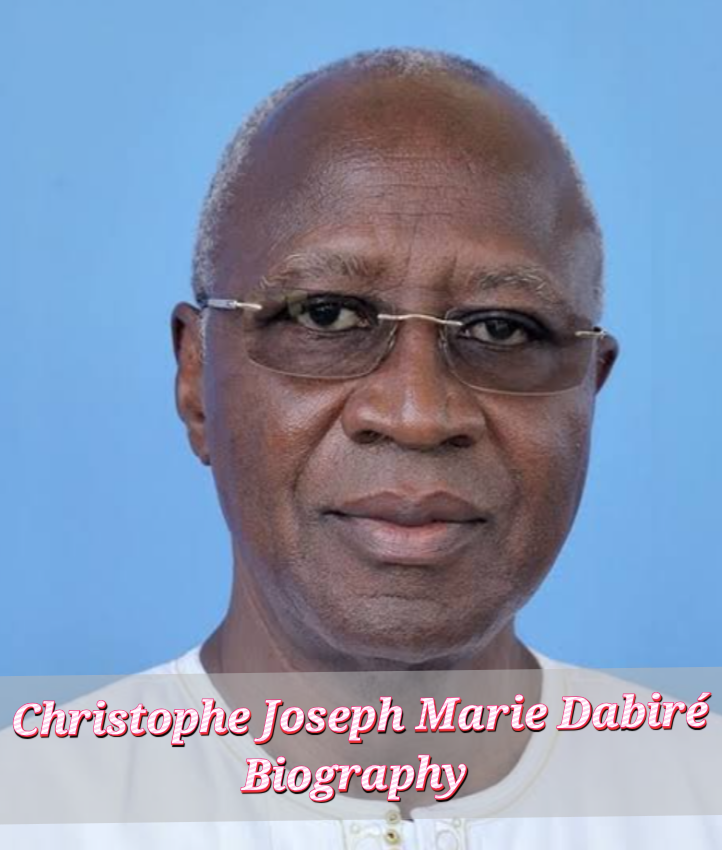
Christophe Joseph Marie Dabiré Biography
Christophe Joseph Marie Dabiré is a well-known politician and economist from Burkina Faso. He was born on 27 August 1948 and spent more than 30 years working in different government jobs. Many people remember him best as the Prime Minister of Burkina Faso from January 2019 until December 2021. During his time as Prime Minister, the country faced serious security problems because of terrorist attacks in the Sahel region. Before that, he served as minister for health and later for education under President Blaise Compaoré. He also worked for the West African Economic and Monetary Union (UEMOA). This article tells his life story in a simple way so everyone can understand his journey and contributions to Burkina Faso.
Christophe Joseph Marie Dabiré Early Life and Education
Christophe Joseph Marie Dabiré was born on 27 August 1948 in Upper Volta, the name of Burkina Faso before 1984. Not much public information exists about his parents or childhood, but he grew up during the years when the country became independent from France in 1960.
He studied economics and completed advanced degrees in France and Burkina Faso. He earned a Diplôme d’Études Approfondies (DEA) in economic sciences and a Diplôme d’Études Supérieures Spécialisées (DESS) in business administration. These qualifications helped him understand how to plan development projects and manage money for a country. His education focused on development economics, which later became very useful when he worked on national plans for Burkina Faso.
Christophe Joseph Marie Dabiré Career
Dabiré started his professional life in the Ministry of Economy and Planning in the 1970s and 1980s. He held important positions such as Director of Studies and Projects and later Director General of Cooperation. In these roles he helped coordinate international aid and development programs.
From 1992 to 1997 he served as Minister of Health and Public Hygiene. During this period he worked to improve hospitals and clinics, especially in rural areas, and supported vaccination campaigns against common diseases.
From 1997 to 2000 he became Minister of Secondary, Higher Education and Scientific Research. He introduced changes to make education better and helped more students go to university.
Between 2000 and 2007 he represented his region as a member of the National Assembly for the Congress for Democracy and Progress (CDP) party. He was elected twice, in 1997 and 2002.
After leaving parliament, he worked as Burkina Faso’s commissioner at the West African Economic and Monetary Union (UEMOA) in Ouagadougou. There he helped strengthen economic ties between eight French-speaking countries that share the CFA franc currency.
In June 2019 he spoke at the International Labour Organization (ILO) conference in Geneva and stressed the need for decent jobs for young people in Africa.
Christophe Joseph Marie Dabiré Appointment as Prime Minister
On 21 January 2019 President Roch Marc Christian Kaboré appointed Christophe Joseph Marie Dabiré as Prime Minister, replacing Paul Kaba Thiéba who had resigned. Dabiré formed a new government with 33 ministers.
After President Kaboré won re-election in November 2020, Dabiré was re-appointed on 5 January 2021 and presented a new cabinet the next day. His second government had 35 members, including new ministers for defense and security because terrorist attacks were increasing in the north and east of the country.
Christophe Joseph Marie Dabiré Resignation
By late 2021 Burkina Faso faced many deadly attacks by jihadist groups linked to Al-Qaeda and Islamic State. Thousands of people died and more than one million citizens had to leave their homes. Many citizens felt the government was not doing enough to stop the violence.
Large protests took place in several cities in November and December 2021. On 8 December 2021 Prime Minister Dabiré and his entire cabinet handed in their resignation to President Kaboré. The president accepted it the same day through an official decree read on national television by government spokesman Stéphane Wendingoudi Sanou. President Kaboré thanked Dabiré for his service and said a smaller and more focused government would be formed. Less than two months later, on 24 January 2022, the army carried out a coup and removed President Kaboré from power.
Christophe Joseph Marie Dabiré Personal Life
Christophe Joseph Marie Dabiré keeps his family life private. No official records or interviews give details about his wife, children, or hobbies. Like many senior African politicians, he prefers to keep personal matters away from the public eye. After leaving office in December 2021 he has stayed out of the media and has not taken any new public position as of November 2025.
Conclusion
Christophe Joseph Marie Dabiré spent more than three decades serving Burkina Faso in different roles: economist, minister, parliament member, regional commissioner, and finally Prime Minister. His work helped improve health services and education in the 1990s. As Prime Minister he tried to manage a very difficult security crisis, but the growing violence made his job extremely hard. His career shows both the achievements possible in public service and the huge challenges leaders face in the Sahel region today. Even though he is no longer in government, his long experience in planning and administration remains an important part of modern Burkina Faso’s history.
FAQs
Who is Christophe Joseph Marie Dabiré?
He is a Burkinabé economist and politician born on 27 August 1948. He served as Prime Minister of Burkina Faso from January 2019 to December 2021.
When was he Prime Minister?
First term: 21 January 2019 to 31 December 2020. Second term: 5 January 2021 to 8 December 2021.
What jobs did he have before becoming Prime Minister?
He was Minister of Health (1992–1997), Minister of Education (1997–2000), member of the National Assembly (2000–2007), and commissioner at UEMOA.
Why did he resign in 2021?
He and his government resigned on 8 December 2021 after large protests against the handling of terrorist attacks and rising insecurity in the country.
What is he doing now (2025)?
Since his resignation he has stayed away from public office and political activities. No new public role has been announced.
Which political party did he belong to?
For many years he was a member of the Congress for Democracy and Progress (CDP), the party of former President Blaise Compaoré.
Did he study abroad?
Yes, he completed advanced degrees in economics and business administration in France and Burkina Faso.
How long did he work in government?
More than 30 years in various high-level positions before becoming Prime Minister.